
Aurora · Repair
Furnace Repair in Aurora
Aurora spans roughly 1,000 feet of elevation and three counties, and its furnaces span about seven decades. A heating call in a 1950s Hoffman Heights ranch looks nothing like one in a 2000s Tallyn's Reach two-story, so we start every visit by figuring out what kind of house and system we're standing in.
Same-dayResponse Time
All ZIPs80010–80019, 80040–80047, 80247
Three generations of Aurora furnaces, three different failure patterns
Hoffman Heights was built fast after World War II: about 1,700 three-bedroom homes between 1950 and 1953, many around 1,055 square feet, aimed at returning veterans working near Fitzsimons and Lowry. Most of those houses have been through several furnaces by now, but they often still have small original supply runs and a single central return. The furnace ends up working against restricted airflow, which shows up as overheating, limit-switch trips and cracked heat exchangers on units that should have years left.
Aurora's biggest building boom came in the 1970s and early 1980s, when the population more than doubled. Homes from that period are now on their second or third furnace, and the common issues are worn inducer motors, failing hot-surface igniters and control boards on 15- to 20-year-old 80% units, plus flue and venting problems where a later high-efficiency furnace was fitted into an old chimney layout.
Southeast Aurora is a different story. Saddle Rock went up mostly between the late 1990s and mid-2000s, and nearly all of Tallyn's Reach was built after 1999. Many of these larger homes have finished basements, two or more stories and builder-grade furnaces that are now 20 to 25 years old. Here we see blower motors, flame sensors, pressure switches and zone dampers giving out, and second floors that never heated evenly in the first place.
Aurora at a Glance
- Elevation
- 5,471 ft
- County
- Arapahoe, Adams and Douglas counties (mostly Arapahoe)
- Permits
- City of Aurora Building Division (applications through the Aurora4Biz portal)
- Gas utility
- Xcel Energy
- Electric utility
- Xcel Energy
- Gas furnace output loss
- ≈22% vs. sea level (about 4% per 1,000 ft)
- Housing
- Median home built around 1985; about 65% single-family. Post-WWII tract homes in Hoffman Heights (about 1,700 built 1950-1953), large 1970s-80s growth, and…
Facts checked November 2026. Sources listed below.
Aurora Climate Note
Aurora's mix of older homes (50+ years) and new builds means we work with everything from gravity furnaces to ultra-modern heat pumps. Dust and pollen are higher than west metro.
Neighborhoods We Serve
Original Aurora, Saddle Rock, Tallyn's Reach, Southshore, Heather Gardens, Cherry Creek Valley, Murphy Creek, Seven Hills, Norfolk Glen
Altitude and long cold snaps work your furnace harder
The city sits at about 5,471 feet at its posted elevation, ranging from roughly 5,285 feet along Sand Creek to over 6,200 feet at the Douglas County line. Gas furnaces are typically derated about 4% per 1,000 feet of elevation, so a furnace that was not set up for altitude, or one with the wrong orifices from a previous install, can burn rich, soot up and produce carbon monoxide. Checking gas pressure and burner setup against the manufacturer's high-altitude table is part of how we diagnose short-cycling or sooting units.
Average December and January lows sit in the upper teens, and the city has recorded lows of -32°F. A furnace that limps through October can quit on the first real cold snap, which is why we see many calls for weak igniters and dirty flame sensors in early winter.
How we work a no-heat call
We start with the basics that cause a surprising share of calls: thermostat settings, filter condition, the furnace door safety switch and the gas valve. Then we read the control board's fault codes, measure gas pressure, test the igniter, flame sensor and pressure switches, and check temperature rise across the heat exchanger. Every furnace visit includes a carbon monoxide and combustion safety test.
You get a flat-rate price before any work begins, with no overtime fees for nights or weekends. The diagnostic is free when you approve the repair. Our trucks carry common parts for Trane, Lennox, Carrier, Goodman, Bryant and Rheem equipment, so most igniter, sensor, inducer and blower repairs are finished on the first visit. Same-day appointments are available when the schedule allows, and emergency service runs 24/7.
Repair or replace: how we'd think about it for homes like yours
A single failed igniter or capacitor on a 12-year-old furnace in a Saddle Rock basement is a repair. A cracked heat exchanger, repeated control-board failures, or a 25-year-old unit in a 1970s home that already needs an inducer motor usually points toward replacement. In older homes, replacement is also the moment to fix the airflow problems that wore out the last furnace.
Replacing a furnace here requires a permit from the City of Aurora Building Division, applied for through the city's online permit portal, followed by inspection. Xcel Energy provides gas and electric service across the city, so Xcel's current rebate rules for heating equipment and heat pumps are the ones to check before you choose a replacement.
Furnace Repair Work Around the Denver Metro
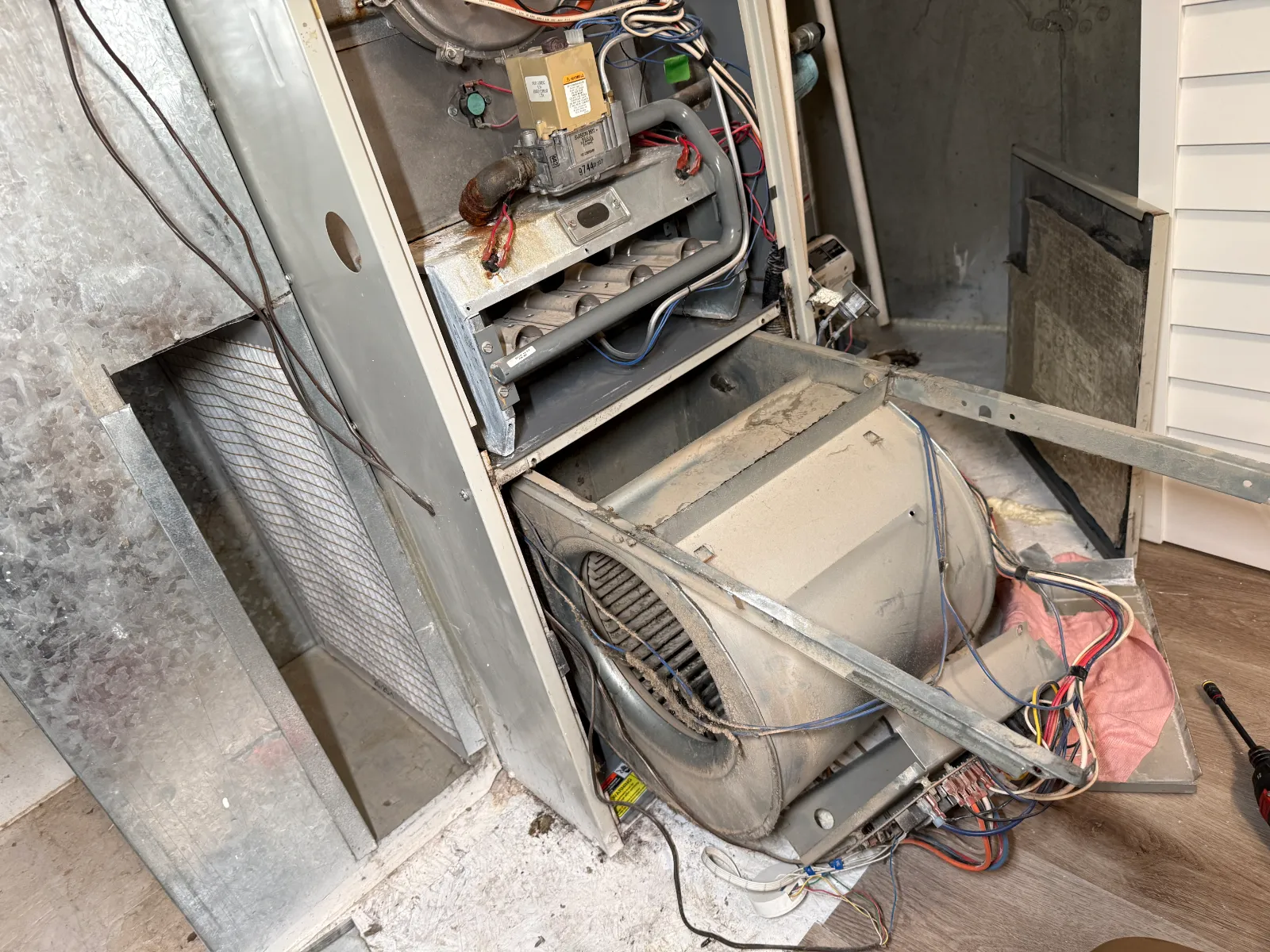
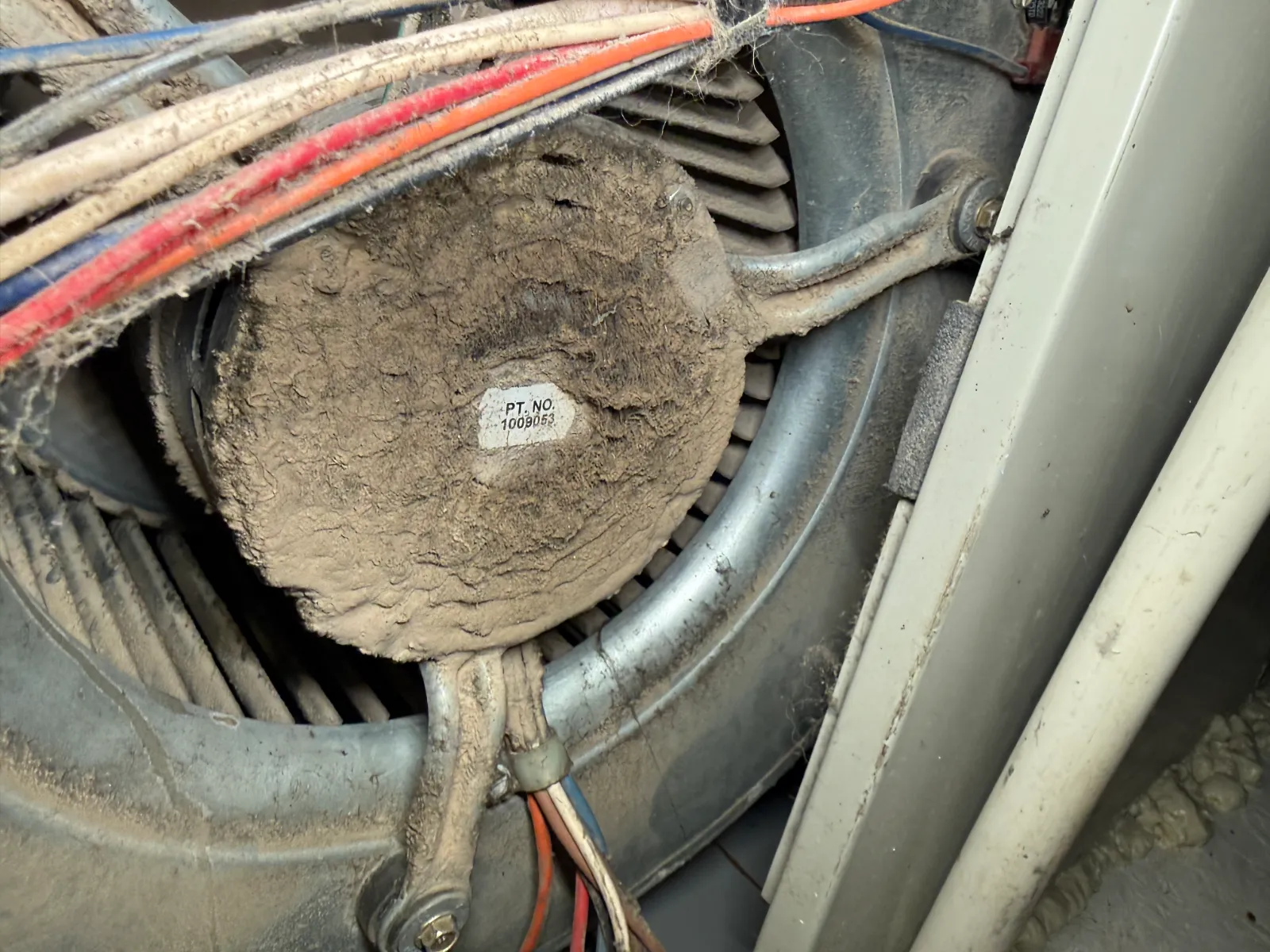
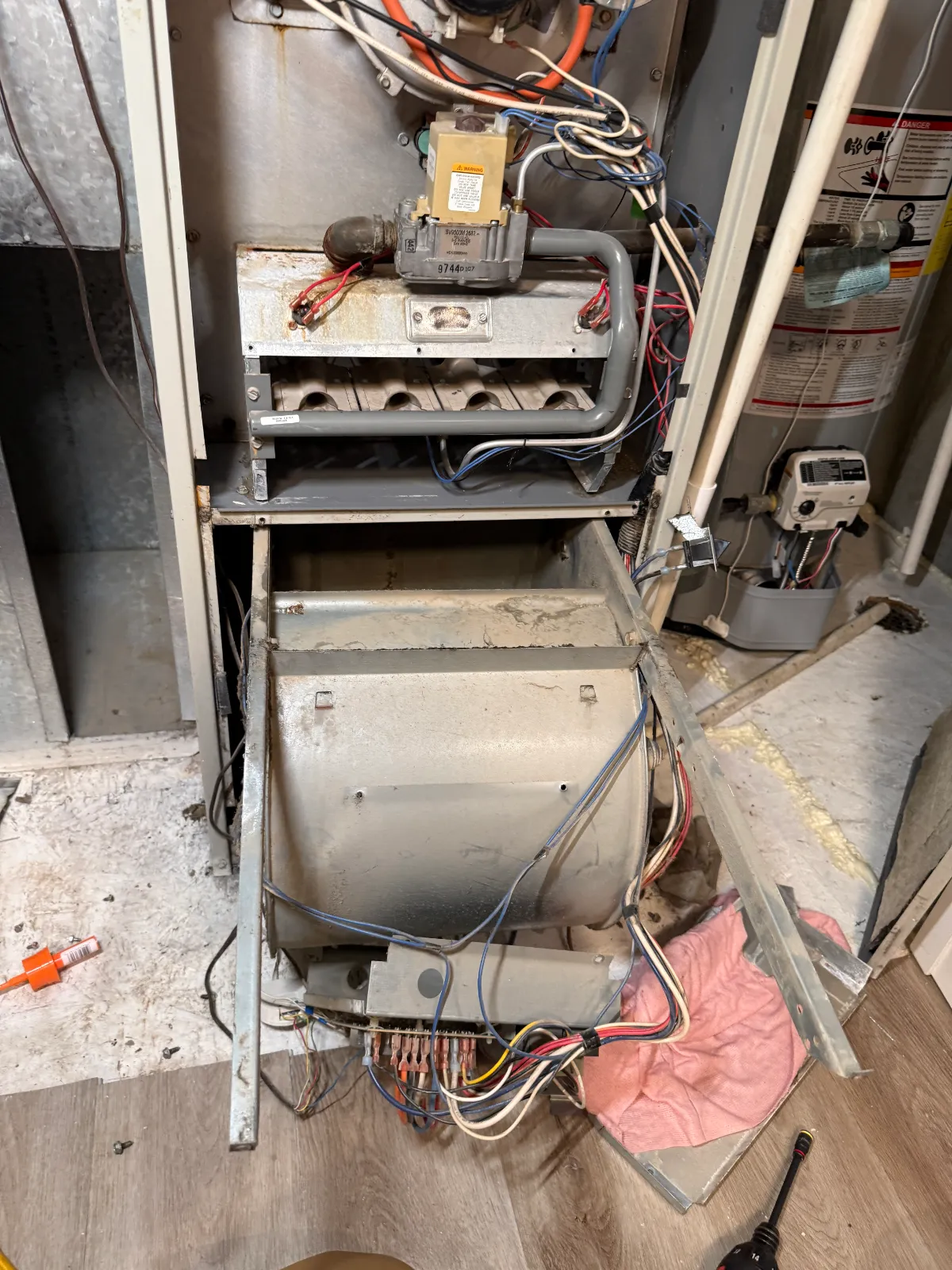
Real photos from MrFixer jobs in nearby communities — the same crew that serves Aurora.

Furnace Repair FAQs — Aurora
My Hoffman Heights furnace keeps shutting off after a few minutes. Why?
In homes built in the early 1950s, small ducts and a single return often restrict airflow. The furnace overheats and the high-limit switch shuts the burners off. A clogged filter makes it worse. We measure temperature rise and static pressure to confirm whether it's airflow or a failing part.
Is my southeast-side furnace too old to repair?
Homes in Saddle Rock and Tallyn's Reach were mostly built from the late 1990s on, so many original furnaces are now 20 to 25 years old. Age alone doesn't decide it. A blower or igniter repair can still make sense. A cracked heat exchanger or several major parts failing at once usually doesn't.
Does elevation really matter for a furnace here?
Yes. The city sits between about 5,285 and 6,229 feet, and manufacturers require gas furnaces to be derated at that altitude. A unit set up for sea level can run rich, soot and make carbon monoxide. We check burner setup and test for CO on every furnace call.
Do I need a permit to replace my furnace?
Yes. Furnace replacement is permitted through the city's Building Division and inspected afterward. Simple repairs like igniters, sensors and motors don't need a permit.
Sources for this Aurora page (9) · checked November 2026
Signs You Need Furnace Repair
01
Furnace not igniting or blowing cold
03
Yellow flame instead of blue

02
Strange noises (rattling, banging, screeching)
04
Frequent cycling or short cycling
More HVAC Services in Aurora
All HVAC services in Aurora · Furnace Repair across the Denver metro
Air Conditioner Repair
Fast, same-day AC repair across Colorado.
Learn moreFurnace Installation
Expert furnace installation for Colorado winters.
Learn moreAir Conditioning Installation
Professional AC system installation for homes and businesses.
Learn moreHeat Pump Installation
Energy-efficient heat pumps for year-round comfort.
Learn moreSeasonal HVAC Tune-Ups
Spring and fall tune-ups to keep systems running smoothly.
Learn moreHeat Pump Repair
Diagnostics and repair for heat pump systems.
Learn moreDuctless Mini-Split Installation
Flexible mini-split systems for any space.
Learn moreFree tools for Aurora homeowners
- Repair or replace calculator — check a repair quote against the age of your system
- Furnace altitude calculator — real heat output at Aurora’s elevation
- Troubleshooting guide — what to check before you call
Our Professionalism Is Reflected in Our Customer's Feedback.
Don't just take our word for it — hear from Colorado homeowners who trust us with their comfort.
Share Your Experience
Your feedback helps us serve Colorado homeowners better.
Local 24/7 Response · Colorado
Our Craftsmanship Is Undeniable.
HVAC emergency? Our team is available 24/7 for urgent heating and cooling repairs across Colorado. Don't wait — call now.
Call For Emergency Service
(720) 466-7983
Available 24 / 7 · 365 days
Free quotes · No obligation
Get Your Free Estimate Today.
Fill out the form below and one of our HVAC experts will get back to you within 30 minutes.
- Free quote in 30 min · no obligation
- Licensed & insured Colorado contractor
- 5★ rated by 1,500+ homeowners
- Same-day service across the Front Range
Phone
(720) 466-7983
Email
info@mrfixer.io
Location
Colorado, CO
Hours
Mon-Sat: 7AM-8PM | Emergency: 24/7