
Key takeaways
- Census data shows about 17% of Denver's housing units were built in 1939 or earlier, and another 18% between 1940 and 1959. Many of these homes have no ducts (boilers and radiators) or only ducts sized for an old gravity or forced-air furnace.
- A ductless mini-split adds efficient heating and cooling without cutting duct chases into plaster walls. Running the refrigerant lines usually takes one small wall penetration per indoor head.
- Cold-climate mini-splits are built for Front Range winters. Mitsubishi rates its Hyper-Heating units at 100% of rated capacity at 5°F, with operation down to −13°F.
- Typical market ranges (HomeGuide, national): $2,500–$6,000 for a single zone and $6,500–$11,000 for three zones, before incentives.
- Keeping your boiler as backup is a reasonable plan. The mini-split handles cooling and most heating hours, and the boiler covers the coldest nights and any rooms without a head.
Denver's older neighborhoods are full of homes that were never designed for central air: brick bungalows in Park Hill and Berkeley, Denver Squares on Capitol Hill and in the Highlands, and post-war ranches with a boiler in the basement. Owners usually want two things, comfortable summers and a heating system that does not depend entirely on a 50-year-old boiler. A ductless mini-split heat pump is often the cleanest way to get both.
This guide explains how mini-splits work, which layout fits which house, how they perform in a Denver winter and at altitude, what installation involves in an older home, and what it typically costs.
Denver's older housing stock: why so many homes lack good ducts
According to U.S. Census Bureau American Community Survey estimates (2019–2023), about 17.2% of Denver's housing units were built in 1939 or earlier and 18.2% between 1940 and 1959. That means roughly one in three homes in the city is more than 65 years old.
Those homes fall into several familiar groups:
- Bungalows. Historic Denver's survey work notes that bungalow and Craftsman homes became popular between 1910 and 1920, especially in Park Hill. In its 1920s small-homes pilot survey, 375 of 1,129 buildings were bungalow types. They are typically one-and-a-half stories with plaster walls, a full or partial basement, and little room for duct chases.
- Denver Squares (Foursquares). These are square-plan, two-or-more-story homes with hipped roofs, common in the Highlands, Capitol Hill, Baker, Whittier and Park Hill. Second floors are notoriously hot in summer, and many were built around boilers and radiators or early gravity furnaces.
- Homes with boilers and radiators. Hot-water and steam systems give pleasant, even heat but provide no cooling. Adding ducted central air means running new ducts through finished spaces.
- Additions, converted porches, finished basements and attic rooms. Even homes with central forced air often have rooms the original ducts never reached, or reach poorly.
Regional data points the same way. HUD's American Housing Survey for the Denver metro found that warm-air furnaces were the main heating equipment in 80.5% of occupied homes, while only 52.4% had central air. That survey is from 2011, but the takeaway still holds: plenty of Denver-area homes either have no ducts or have no cooling.
How a ductless mini-split heat pump works
A mini-split is a split-system heat pump: an outdoor unit with the compressor connects to one or more indoor "heads" through a pair of small refrigerant lines, a control cable and a condensate drain. Like every heat pump, it moves heat instead of making it by burning fuel.
- Evaporate outside. Cold liquid refrigerant in the outdoor coil absorbs heat from outdoor air, which still holds heat well below freezing, and boils into a vapor.
- Compress. A variable-speed inverter compressor squeezes the vapor, raising its temperature.
- Condense inside. The hot vapor flows to the indoor head, where a fan blows room air across the coil. The refrigerant gives up its heat and condenses to a liquid.
- Expand. An expansion valve drops the pressure and temperature so the refrigerant can pick up heat outdoors again.
In summer a reversing valve runs the cycle backward, and the same equipment becomes a high-efficiency air conditioner.
Efficiency is measured as COP (coefficient of performance), which is heat delivered divided by electricity used. A gas boiler or furnace is rated in AFUE and can never exceed 100%, while a heat pump routinely delivers two to three units of heat per unit of electricity in mild weather. ENERGY STAR's cold-climate criteria require a COP of at least 1.75 even at 5°F. In cold weather the outdoor coil can frost over, so the unit briefly runs a defrost cycle and drains meltwater from the outdoor unit. That is why placement and drainage matter in a snowy climate.
Why inverter compressors matter
Older single-speed heat pumps ran either on or off. Inverter-driven mini-splits slow down or speed up to match the load, so they run long, quiet, low-power cycles. That keeps room temperatures steady and holds capacity better as it gets colder outside.
Single-zone vs. multi-zone
| Single-zone | Multi-zone | |
|---|---|---|
| Layout | One outdoor unit to one indoor head | One outdoor unit to several heads (Mitsubishi notes up to eight on some systems) |
| Best for | One problem area: a hot upstairs bedroom, an addition, a finished basement, a garage office | Several rooms or a whole small house |
| Efficiency | Generally the highest, because the compressor is matched to one load | Good, but small rooms can cause short cycling if heads are oversized |
| Redundancy | Multiple single-zone systems mean one failure does not shut everything down | One outdoor unit serves every head |
| Outdoor footprint | One condenser per zone | One condenser total |
| Typical market range | $2,500–$6,000 (HomeGuide, national) | $4,500–$8,000 (2 zones), $6,500–$11,000 (3 zones), $10,000–$15,000 (5 zones) (HomeGuide, national) |
A common mistake is putting a head in every small room. A 9,000 BTU head in a 100 sq ft bedroom that needs a fraction of that will cycle on and off and dehumidify poorly. A careful designer runs a room-by-room Manual J load calculation and may cover two small rooms with one ducted head, or leave a low-load room to the existing boiler.
Indoor head types
| Head type | Where it fits | Trade-offs | Typical single-zone installed range* |
|---|---|---|---|
| Wall-mounted | Most rooms; mounted high on an exterior wall | Lowest cost and simplest install, but most visible | $2,500–$5,000 |
| Ceiling cassette | Rooms with joist space above (a top-floor ceiling under an attic, or a basement ceiling) | Discreet, but needs ceiling cavity depth and more labor | $3,500–$6,000 |
| Floor-mounted console | Under windows, attic knee walls, spots where a radiator used to be | Good for heating because warm air starts low, but uses floor space | $3,000–$5,000 |
| Concealed (slim) ducted | Hidden in a closet, soffit or attic, with short ducts serving 1–3 nearby rooms | Nearly invisible; needs space for the air handler and short duct runs | $4,000–$7,500 |
*HomeGuide national market ranges, not MrFixer quotes.
In historic homes, many owners mix types: a slim ducted unit in the attic for the upstairs bedrooms, a floor console in the living room where the old radiator stood, and a wall head in the finished basement.
Cold-climate performance in Denver
Denver's January mean temperature is 31.7°F under NWS 1991–2020 normals, with typical January lows in the upper teens. Arctic outbreaks can drop well below zero, and the city's record low is −29°F (1875). A mini-split for a Denver home should therefore be a true cold-climate model:
- Look for ENERGY STAR cold-climate certification (COP ≥ 1.75 at 5°F, and at least 70% of rated capacity at 5°F versus 47°F) or a listing on the NEEP cold-climate heat pump list.
- Check the manufacturer's capacity at your design temperature. For example, Mitsubishi says its Hyper-Heating (H2i) units deliver 100% of rated capacity at 5°F with guaranteed operation down to −13°F, and its multi-zone Hyper-Heat outdoor unit makes the same 5°F claim.
- Understand your balance point: the outdoor temperature at which the heat pump's output equals the home's heat loss. Below it you need backup heat, which in an older home is often the boiler you already have.
For more on winter performance, see Do heat pumps work in a Denver winter?
Altitude: what changes at 5,280 feet
Thinner air carries less heat per cubic foot. Manual J's altitude adjustment factor at 5,000 ft is about 0.84 of the sea-level value, as cited in ACHR News. In practice:
- Indoor fans move less mass of air at the same speed, so a head's delivered capacity can be a bit lower than its sea-level rating. Good designers use the manufacturer's altitude data rather than nameplate numbers.
- This is one more reason to size from a real load calculation and not to buy the smallest head that "should" work.
Installation details in an older home
- 1Room-by-room load calculation
Manual J with Denver design temperature and altitude adjustment sets head sizes.
- 2Plan head and line routes
Choose wall, cassette, floor or slim ducted heads; route lines through closets or attics where possible.
- 3Electrical and permits
Dedicated 240V circuit and disconnect; pull mechanical and electrical permits.
- 4Mount outdoor unit above snow line
Stand or wall bracket clear of roof drip lines, with a drainage path for defrost water.
- 5Mount heads and run line sets
Core-drill and seal penetrations, install line-hide covers, route condensate by gravity or pump.
- 6Vacuum, charge and commission
Pressure-test and evacuate lines, verify charge and airflow, set up controls and boiler backup setpoints.
Line sets and wall penetrations
Each head needs a refrigerant line set, a control wire and a condensate drain running to the outdoor unit. Typically that means one small hole through the exterior wall behind or near the head. On brick or stone, the installer core-drills and seals the penetration. Outside, lines run in a paintable line-hide cover rather than as bare insulation. In multi-story homes, lines can often run up through closets or attic spaces to avoid long exterior runs. Angi lists refrigerant line at roughly $5 per foot and an installation kit at $300–$500, so long runs add up.
Condensate drainage
In cooling mode, and on the outdoor unit during defrost, mini-splits produce water. Indoor heads drain by gravity through the wall when possible. Heads on interior walls or below grade (basements) need a small condensate pump. Outdoors, defrost water must drain away from walkways so it does not form ice sheets in winter.
Outdoor unit placement
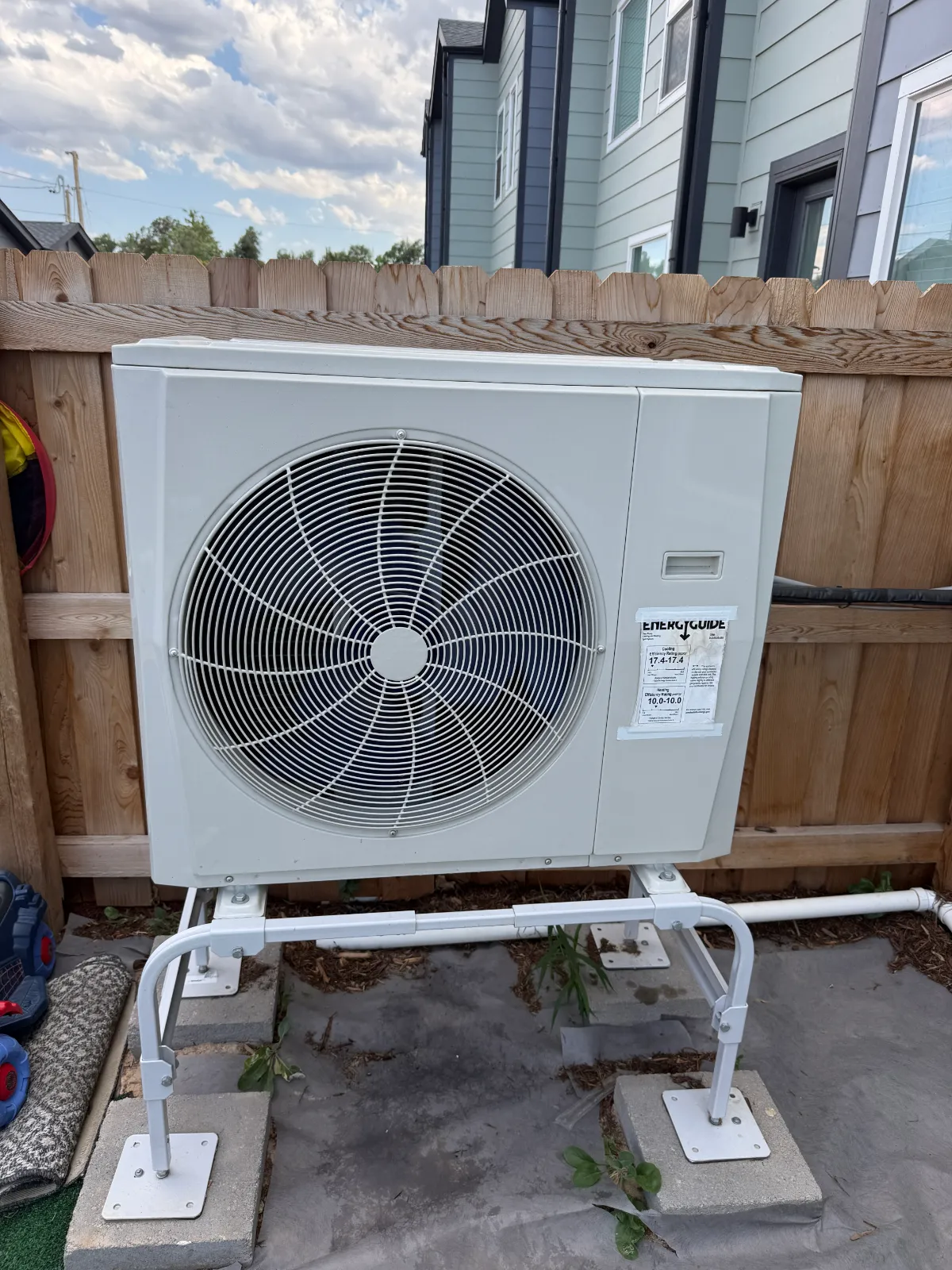
Mitsubishi advises mounting heat pumps above your local snow line and keeping the unit clear of snow and ice. In Denver that usually means a raised stand or wall bracket, kept out from under a roof drip line, with clearance so defrost water and snow do not block the coil.
Electrical
Each outdoor unit needs a dedicated 240-volt circuit and an outdoor disconnect. Angi estimates a dedicated circuit at about $250 extra. In an older home with 60- or 100-amp service or a full panel, have an electrician run a load calculation. Mini-splits draw modest current and often fit, but if your service is undersized the panel upgrade can rival the cost of a head.
Permits
Mechanical and electrical work in Denver-area jurisdictions generally needs a permit and inspection. Angi and HomeGuide list typical mini-split permit costs around $250–$400 nationally. If your home is in a designated historic district, ask about exterior placement rules for outdoor units and line covers before installation.
Keeping your boiler as backup
You do not have to tear out a working boiler to go electric. Many owners of older homes use a "hybrid" approach:
- Mini-split first. Set the heads as the main heat for spring, fall and most winter days. They also provide cooling, which the boiler never did.
- Boiler as backup. Set the boiler thermostat a few degrees below the mini-split setpoint. On the coldest nights, or in rooms without a head, the boiler picks up the slack automatically.
- Keep the boiler maintained. Running less does not mean you can skip service. Have it checked before each heating season.
This setup avoids sizing the mini-split for the single coldest hour of the year, which keeps costs down and avoids oversized heads that short-cycle in mild weather. If you want to retire the boiler later, a whole-home ducted or dual-fuel system may be an option once ducts are added, and air-to-water heat pumps that work with radiators are also on the market.
Maintenance
- Filters: Indoor heads have washable mesh filters. Rinse them regularly; Mitsubishi suggests starting each month with a freshly cleaned filter. Clogged filters cut airflow and efficiency fast.
- Coil and blower-wheel cleaning: Dust and biofilm build up on the indoor coil and the squirrel-cage blower over time. Professional cleaning keeps airflow up and prevents musty odors.
- Outdoor unit: Keep it clear of snow, ice, leaves and cottonwood fluff, and keep shrubs back.
- Condensate: Check that drain lines flow and condensate pumps work before cooling season.
- Annual checkup: Have a technician inspect the system before cold weather, especially once it is a few years old. MrFixer offers heat pump service and repair.
What mini-splits cost (market ranges)
| Configuration | Typical installed range | Source |
|---|---|---|
| Single zone | $2,500–$6,000 | HomeGuide |
| 2 zones | $4,500–$8,000 | HomeGuide |
| 3 zones | $6,500–$11,000 | HomeGuide |
| 5 zones | $10,000–$15,000 | HomeGuide |
| 8 zones | $18,000–$20,000+ | HomeGuide |
| Overall installed range | $2,500–$15,000+ | Carrier |
These are national market ranges, not MrFixer quotes. Cold-climate models, ceiling cassettes, long line runs, masonry penetrations, condensate pumps and electrical upgrades push toward the top of each range. For a wider look at heat pump pricing in the metro, including ducted systems, see heat pump installation cost in Denver.
Rebates and credits (as of November 2026)
- The federal 25C credit ended for equipment placed in service after December 31, 2025.
- The Colorado heat pump tax credit for air-source heat pumps installed in 2026 requires an ENERGY STAR, AHRI-matched system installed by a registered contractor, and you receive at least $333 as an invoice discount. The Colorado Energy Office does not list mini-splits separately, so confirm eligibility for your specific system.
- Power Ahead Colorado offers $1,500 for cold-climate air-source heat pumps in existing buildings in participating DRCOG communities. The contractor must submit the project before work begins.
- Xcel Energy rebates depend on how much of the home's heating load the system covers. Installer reports from October 2026 say a supplemental ductless system that covers less than half the heating load, or heats a previously unconditioned room, now gets a flat $500, while larger systems qualify for per-ton cold-climate rebates. Confirm with Xcel before you buy.
Full details are in our Colorado heat pump rebates and tax credits guide, and our rebate assistance team can help with paperwork.
When a mini-split is not the best answer
- If your home already has good, well-sized ducts, a ducted cold-climate heat pump or high-efficiency upgrade may cost less per ton and hide everything from view.
- If you need heat in eight small rooms, a multi-zone system can get expensive. One or two slim ducted units may serve the house better.
- If you object to visible wall heads, budget for cassettes or concealed ducted units.
- If your boiler is young and you mostly want cooling upstairs, a single-zone head for the second floor may be all you need.
MrFixer Heating & Cooling is based in Castle Pines and installs ductless mini-splits, heat pumps, furnaces and dual-fuel systems across the Denver metro. We are licensed and insured, offer free in-home estimates and have financing available. Call (720) 466-7983 or request an estimate.
Frequently asked questions
Can a mini-split heat my older Denver home in winter?
Yes, if it is a cold-climate model sized from a load calculation. ENERGY STAR cold-climate units must deliver a COP of at least 1.75 and at least 70% of rated capacity at 5°F, and some models (such as Mitsubishi Hyper-Heating) are rated at 100% capacity at 5°F. Many owners keep their boiler as backup for the coldest nights.
Do I have to remove my boiler and radiators?
No. A common approach is to run the mini-split as primary heat and cooling and keep the boiler set a few degrees lower as automatic backup.
How much does a ductless mini-split cost?
HomeGuide's national market ranges are about $2,500-$6,000 for one zone, $6,500-$11,000 for three zones and $10,000-$15,000 for five zones before incentives. These are market ranges, not MrFixer quotes.
How big is the hole in the wall for a mini-split?
Usually one small penetration per head for the refrigerant lines, control wire and condensate drain. It is sealed and covered outside with a paintable line-hide cover. On brick, the installer core-drills the hole.
Single-zone or multi-zone: which is better?
Single-zone systems are the most efficient and give redundancy for one or two problem areas. Multi-zone systems use one outdoor unit for several rooms but can short-cycle if small rooms get oversized heads. A room-by-room Manual J calculation decides.
How do I maintain a mini-split?
Rinse the washable filters regularly (Mitsubishi suggests a clean filter each month), keep the outdoor unit clear of snow and debris, check condensate drains, and have a technician inspect and clean the coils and blower periodically, ideally before winter.
Sources (19)
- point2homes.com point2homes.com/US/Neighborhood/CO/Denver-Demographics.html
- huduser.gov huduser.gov/PORTAL/periodicals/USHMC/ahs//Denver_CO_factsheet2011.pdf
- historicdenver.org historicdenver.org/wp-content/uploads/sites/7422/2024/07/1920s-Small-Homes-Survey-Report-F
- historicdenver.org historicdenver.org/wp-content/uploads/2017/05/Denver%E2%80%99s-Historic-Neighborhoods-2016
- bsesc.energy.gov bsesc.energy.gov/sites/default/files/2024-10/Types-of-Air-to-Air-Heat-Pumps_Factsheet.pdf
- energystar.gov energystar.gov/products/air_source_heat_pumps/key-product-criteria
- mitsubishicomfort.com mitsubishicomfort.com/articles/mythbusters-heat-pumps-for-extreme-cold-climates
- mitsubishicomfort.com mitsubishicomfort.com/press-releases/industry-leading-hyper-heating-inverter-r-mxz-outdoor
- mitsubishicomfort.com mitsubishicomfort.com/articles/winter-weather-ready
- mitsubishicomfort.com mitsubishicomfort.com/articles/home-without-ductwork
- weather.gov weather.gov/bou/Climate_Record_January
- achrnews.com achrnews.com/articles/110408-selecting-heating-cooling-units-for-high-altitude-homes
- homeguide.com homeguide.com/costs/ductless-mini-split-ac-cost
- angi.com angi.com/articles/how-much-does-it-cost-install-ductless-mini-split-ac.htm
- carrier.com carrier.com/residential/en/us/products/ductless-mini-splits/ductless-mini-split-installati
- energyoffice.colorado.gov energyoffice.colorado.gov/hptc
- poweraheadcolorado.org poweraheadcolorado.org/resources/rebate-program-overview
- irs.gov irs.gov/newsroom/faqs-for-modification-of-sections-25c-25d-25e-30c-30d-45l-45w-and-179d-un
- unicolorado.com unicolorado.com/xcel-heat-pump-rebate-cut-october-2026/
We'll measure the house, run a load calculation and give you written prices for each option before any work starts.
Get a Free Estimate or call (720) 466-7983