
Key takeaways
- Yes, a properly chosen and sized cold-climate heat pump can heat a Denver home through a normal winter. Standard heat pumps from 15 years ago are a different story.
- Denver is colder in the record books than in day-to-day life. NOAA hourly data averaged only about 91 hours a year below 5°F and about 44 hours below 0°F. In our calculation from those bins, only about 4% of a typical home's yearly heating need falls below 5°F.
- Output and efficiency do fall as it gets colder. In NREL lab tests in Golden, one cold-climate mini-split's efficiency (COP) fell from 2.77 at 47°F to 2.0 at 5°F and about 1.3 at -22°F. Even then, it was still more efficient than electric resistance heat.
- Altitude matters. At Golden's 5,860 feet, NREL measured about 5–7% less capacity than at sea level, so sizing has to account for it.
- Plan for backup heat (electric strips or your existing furnace), defrost cycles, and an outdoor unit raised above snow and roof drip lines.
It's the first question almost every Denver homeowner asks when a heat pump comes up: "What happens when it's ten below?" Older heat pumps earned a bad reputation on the Front Range by blowing lukewarm air and leaning on expensive electric backup. The technology has changed a lot since then, and Denver's climate is milder, hour by hour, than its record lows suggest.
This guide works through the numbers: what makes a heat pump "cold-climate," how cold Denver actually gets and for how long, what independent tests show, and what to plan for with defrost, backup heat, altitude, and snow. We'll also tell you when a heat pump isn't the right answer.
The short answer
A modern variable-speed, cold-climate air-source heat pump can carry most Denver homes through nearly every hour of a typical winter. It needs to be sized for the house with a proper load calculation and installed with Colorado conditions in mind. For the handful of coldest hours each year, most installations include backup heat. That can be electric resistance strips in the air handler or, in a dual-fuel system, your gas furnace.
Whether a heat pump is the cheapest way to heat your particular home is a separate question, and the answer depends on gas and electric rates. We cover that in heat pump vs. furnace in Colorado.
What makes a heat pump "cold-climate"?
A heat pump doesn't burn fuel. It uses electricity to move heat from outdoor air into your house, the same way your refrigerator moves heat out of the food compartment. There is still usable heat in air at 0°F. The colder it gets, though, the harder the compressor has to work to collect it.
Cold-climate models handle this with variable-speed (inverter) compressors. These can ramp up well past their nominal speed when it's cold and slow down to a gentle simmer in mild weather. They also use refrigerant circuits designed for low outdoor temperatures. Two widely used benchmarks define the category:
- NEEP Cold Climate Air-Source Heat Pump Specification: requires a variable-capacity compressor and a COP above 1.75 at 5°F at maximum capacity. Manufacturers must also publish performance at 47°F, 17°F, 5°F, and the lowest temperature they catalog.
- ENERGY STAR Cold Climate criteria: COP at 5°F of at least 1.75, and heating capacity at 5°F of at least 70% of capacity at 47°F, plus minimum SEER2/HSPF2 ratings.
Xcel Energy's Colorado rebate program has used the same 1.75 COP and 70% capacity thresholds to define "cold climate" equipment. See our Colorado rebates guide for current program terms.
COP vs. AFUE, in plain English
AFUE (for furnaces) is the share of the fuel's energy that ends up as heat in your house. A 96% AFUE furnace turns 96 units of gas energy into 96 units of heat. It can never go above 100%.
COP (coefficient of performance) is heat delivered divided by electricity used. A COP of 2.0 means 2 units of heat for every 1 unit of electricity, which is 200% "efficient," because the heat pump is moving heat rather than making it. Electric resistance heat (baseboards or furnace strips) always has a COP of 1.0. As long as a heat pump's COP stays above 1, it's beating resistance heat.
What manufacturers claim at low temperatures
These are manufacturer or trade-press claims for specific product lines. Actual performance depends on the exact outdoor/indoor pairing, so always check the submittal data for the specific model in your quote.
| Product line | Published low-temperature claim | Source |
|---|---|---|
| Mitsubishi Hyper-Heat (e.g., MSUZ-AK48NLHZ outdoor unit) | 100% heating capacity down to 5°F; guaranteed heating down to -13°F | Distributor product listing |
| Mitsubishi Electric (select products) | Guaranteed operation down to -22°F | ACHR News, 2025 |
| Bosch IDS Ultra | 100% heating capacity down to 5°F, COP of 2.1; supports climates as low as -13°F | Bosch launch release, Oct. 2024 |
| Fujitsu Airstage Orion XLTH+ (9k–15k Btu/h wall mount) | More than 90% of nominal capacity at -22°F | ACHR News, 2025 |
"Operates down to" is not the same as "carries your whole house at." A unit that keeps running at -13°F may produce much less heat than your home needs at that temperature. That gap is what backup heat is for.
How cold does Denver actually get?
Denver's all-time record low is -29°F, set January 9, 1875. The second-coldest reading on record is -25°F on December 22, 1990. The longest subzero stretch the National Weather Service has on file is 115 consecutive hours at or below 0°F, December 21–25, 1983. Cold snaps like that are real, and your system should be designed so the house stays safe and warm through one.
What decides a heat pump's performance and your bill, though, is how many hours you spend at each temperature. NOAA's Engineering Weather Data for Denver tallies annual hours in 5°F "bins." Here is what the average year looked like:
- About 2,800 hours a year below 40°F. That's the heating season, and most of it is spent between 20°F and 40°F.
- About 91 hours below 5°F, roughly 1% of the year.
- About 44 hours below 0°F.
- Design temperatures from the same dataset: -2°F at the 99.6% level and 4°F at the 99% level. These are the cold-weather values HVAC designers typically size around.
Two caveats. First, this dataset comes from the old Stapleton airport station, 1973–1995. Recent winters have generally been milder. The NWS lists 2025–2026 as Denver's second-warmest December–February on record. So these hours are, if anything, conservative. Second, homes at higher elevation or in low spots where cold air pools can run colder than the airport station.
Heating demand grows as it gets colder, so we weighted each bin by how far it sits below 65°F. By that calculation (ours, not NOAA's), only about 4% of a typical Denver home's annual heating need falls below 5°F, and about 2% below 0°F. In other words, a cold-climate heat pump is doing the work during the hours that matter most for comfort and cost.
What independent testing shows
NREL lab tests in Golden (funded by Xcel Energy)
The most Colorado-specific data comes from a 2024 National Renewable Energy Laboratory report. NREL tested two Bosch cold-climate systems in its HVAC lab in Golden, at about 5,860 feet. The ducted system measured a COP of 1.93–2.06 at 5°F, depending on airflow, close to the manufacturer's 2.02. The multi-zone mini-split was tested all the way down to -25°F:
| Outdoor temp | Measured COP (max capacity) | Measured heat output | Manufacturer-listed output |
|---|---|---|---|
| 47°F | 2.77 | 31,600 Btu/h | 28,000–38,000 Btu/h |
| 17°F | 2.29 | 24,200 Btu/h | 26,000–26,600 Btu/h |
| 5°F | 2.0 | 20,400 Btu/h | 24,000–25,000 Btu/h |
| -22°F* | ~1.3 | 11,400 Btu/h | 13,550 Btu/h |
*Interpolated by NREL from -20°F and -25°F test points. Source: NREL/TP-5500-89413 (2024).
The takeaways are honest ones. Efficiency stayed well above resistance heat even at -22°F. Capacity, though, dropped substantially, and it came in 7–18% below the manufacturer's numbers at cold test points. NREL attributes part of that to the indoor-unit configuration and to elevation. The report also cautions that only two products from one manufacturer were tested and that the lab is not a certified rating facility.
When Xcel first described these results in 2023, its framing drew criticism. Colorado Public Radio reported that the preliminary findings were based on lab testing of a single model. A Colorado building-science contractor also disputed the company's description, saying his firm had installed hundreds of heat-pump-only systems in Colorado with good results. The published report is the better reference. It shows real limits, not a dealbreaker.
The DOE Cold Climate Heat Pump Challenge
The U.S. Department of Energy's Challenge field-tested prototype cold-climate units from eight manufacturers in occupied homes across the northern U.S. and at a Canadian test house from 2022 to 2024. In lab testing, all prototypes delivered at least their full rated capacity at 5°F. In the field, compressor-only heating COP ranged from about 1.8 at -15°F to 3.5 at 45–55°F.
The same field study found that backup-heat use at very cold temperatures varied enormously, from near 0% to about 90% of energy use depending on the home. Researchers tied that mostly to thermostat and control settings, not just the equipment. Setup matters as much as the brand.
Altitude: the Denver-specific factor
At 5,280 feet, air is roughly 15% less dense than at sea level. A heat pump's outdoor coil moves heat by moving air, so thinner air means a little less heat moved per fan rotation. NREL measured it directly in Golden:
- Ducted system: about 5.5% less capacity and 4.7% lower COP than at sea-level airflow.
- Mini-split: about 7.4% less capacity and about 9% lower COP.
Both losses were a bit smaller than the 8–10% derate that ACCA Manual S recommends. Either way, a contractor who sizes from sea-level catalog numbers is starting about 5–10% short. Ask how altitude was handled in your load calculation and equipment selection. We go deeper in heat pump sizing at altitude (Manual J).
NREL also found that duct static pressure mattered. When ducts were restrictive, airflow dropped and so did capacity and cold-weather COP. Undersized returns are common in older Denver homes, so a duct check belongs in every heat pump quote.
Defrost cycles, explained
In heating mode the outdoor coil runs colder than the outdoor air. When that coil is below freezing, moisture in the air freezes onto it. Frost insulates the coil and blocks airflow, so the heat pump periodically melts it off. This is normal, and it's the source of most "my heat pump is smoking!" calls. It's steam, not smoke.
- 1Frost builds
In heating mode the outdoor coil runs below freezing and moisture in the air freezes on it, reducing airflow and output.
- 2Control detects it
A timer plus coil sensor, or a demand-defrost board comparing air and coil temperatures, decides a defrost is needed.
- 3Valve reverses
The reversing valve switches to cooling mode, sending hot refrigerant gas to the outdoor coil. The outdoor fan stops.
- 4Indoor air tempered
Backup heat (strips or, on some dual-fuel systems, the furnace) may run briefly so supply air doesn't feel cool.
- 5Frost melts
Ice melts and drains; you may see steam rising from the unit. This is normal.
- 6Back to heating
When the coil reaches its termination temperature (or a time limit, e.g. 14 minutes on one common board), normal heating resumes.
How defrost is triggered depends on the control:
- Time/temperature: older boards check the coil at a set interval (commonly 30, 60, or 90 minutes) and defrost only if the coil is below about 30°F.
- Demand defrost: sensors compare outdoor air and coil temperatures and defrost only when the difference shows frost is building. Modern inverter units use this approach, which wastes less energy.
Defrost ends when the coil warms past a set point or a safety time limit runs out. On one common replacement control board, the default termination is 70°F and the maximum defrost time is 14 minutes. Many defrosts end much sooner.
What you'll notice: the outdoor fan stops, you may hear a "whoosh" as the reversing valve shifts, and a cloud of vapor rises off the unit. Indoors, airflow may feel cooler for a few minutes unless backup heat tempers it. Denver's generally dry air helps, because there is less moisture available to freeze onto the coil.
Two things to watch: meltwater needs somewhere to go (more on that below), and frequent, long defrosts or a coil that stays iced over are service calls, not normal operation. See heat pump repair.
Backup heat: strips or a furnace?
Most Denver heat pump installs include some form of backup for the coldest hours, for defrost tempering, and for redundancy if the outdoor unit ever fails in January.
| Electric resistance strips | Existing or new gas furnace (dual fuel) | |
|---|---|---|
| How it works | Heating elements in the air handler, sized in kW | The heat pump coil sits on the furnace; controls switch between them |
| Efficiency | COP 1.0 (1 kW of electricity gives 3,412 Btu/h of heat) | AFUE 80–98% depending on furnace |
| Operating cost when used | Highest per unit of heat | Usually cheaper than strips at Colorado gas prices |
| Upfront cost | Lower; no gas appliance to maintain | Lowest if you keep a healthy furnace |
| Electrical load | Large: a 10 kW kit draws about 42 amps at 240 V. May trigger a panel upgrade. | Small |
| Fully electric home? | Yes | No; you keep gas service and its fixed monthly charge |
| Best fit | Tight, well-insulated homes where the heat pump covers almost every hour | Larger or leakier homes, or homes with a newer furnace |
Controls matter more than hardware here. NEEP's cold-climate installation guide recommends an outdoor-temperature lockout so central backup heat can't run above a set point, typically somewhere between 20°F and 35°F. Otherwise the thermostat may call strips just because you bumped the setpoint up two degrees. The DOE field study's wide spread in backup use (near 0% to about 90%) is the cautionary tale.
Dual-fuel economics are their own topic. See dual-fuel heat pump + furnace systems in Colorado.
Snow, ice, and where the outdoor unit goes
Denver snow usually melts fast, but spring storms are heavy. March averages 11.5 inches, more than January or February. A heat pump also makes its own ice in the form of defrost meltwater. Good placement prevents most winter service calls.
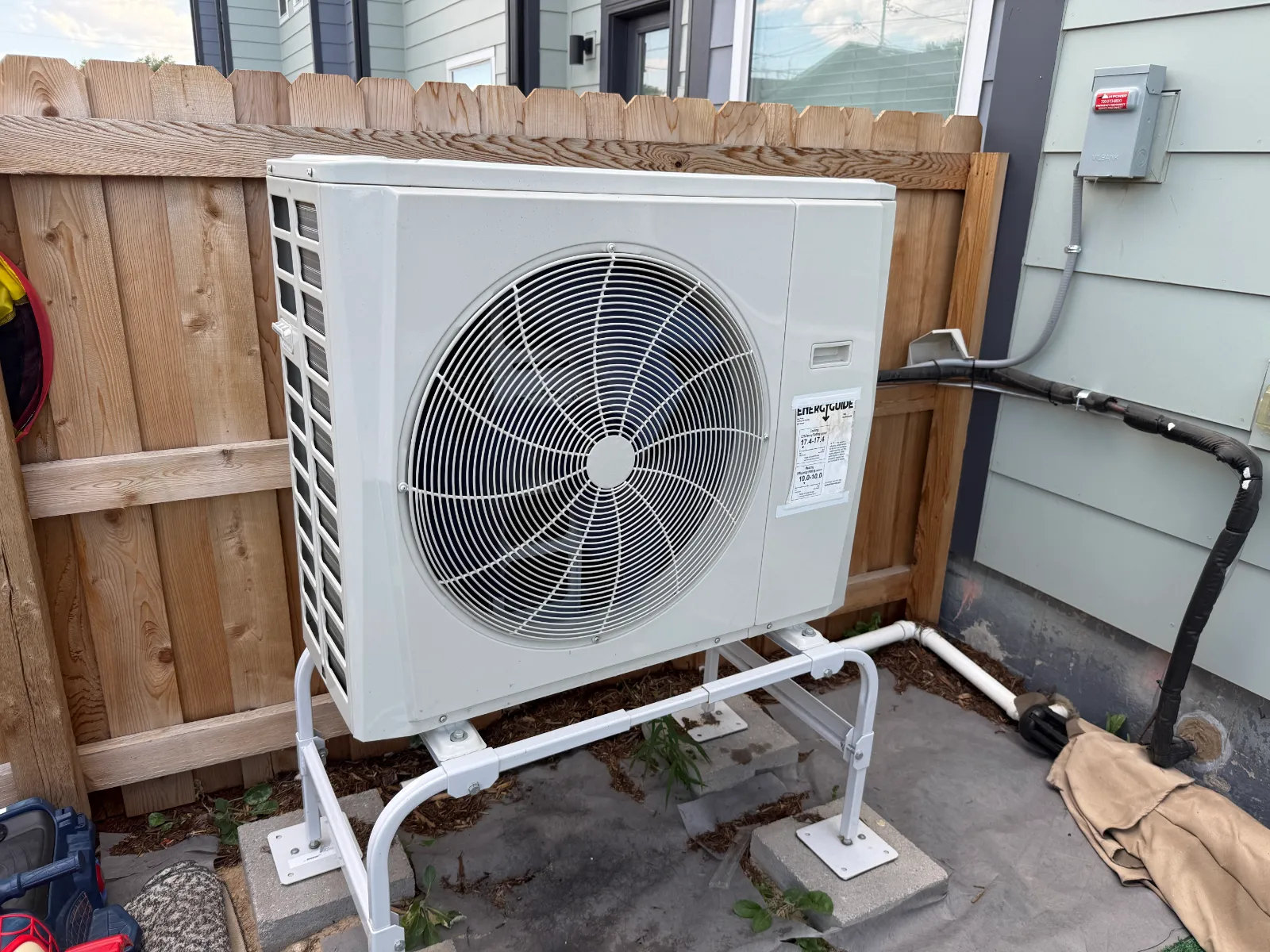
- Raise it. NEEP's installation guide calls for clearance above typical snow depth, using a factory-approved stand, risers, or wall brackets. A unit sitting on a pad at grade can get buried or block its own drainage.
- Stay out from under drip lines. Don't place the unit under a roof edge or overhang that sheds snowmelt or icicles onto it. If you can't avoid it, use a manufacturer-approved drip cap or shield.
- Plan for meltwater. Defrost water refreezes. Keep the unit away from walkways, driveways, and steps where that ice becomes a slip hazard, and route any condensate drain downhill and away from the foundation.
- Respect clearances. Follow the manufacturer's minimum distances from walls and obstructions so air can flow freely, and don't aim one unit's discharge at another.
- Solid footing. Ground mounts need well-drained soil that won't heave with frost, and the unit must be level.
- Homeowner job: after a big storm, gently brush snow off the top and clear drifts from the sides. Never chip ice off the coil fins.
When a heat pump alone isn't the best answer
We install heat pumps, furnaces, and dual-fuel systems, so we don't need to push one. Here's where heat-pump-only can be the wrong call:
- Leaky or under-insulated homes with large heat loss at design temperature may need oversized equipment or lots of strip heat. Air sealing and insulation first, or dual fuel, often makes more sense.
- Restrictive ductwork that can't move the higher airflow heat pumps prefer. Fixing ducts, or going ductless for part of the house, may be required. See ductless options for older homes.
- A furnace that's only a few years old. Adding a heat pump to it (dual fuel) can capture most of the benefit without scrapping good equipment.
- Electrical panels at capacity, where a large strip-heat kit would force a costly service upgrade.
Heat pump-only tends to shine in tight homes, homes replacing both an aging furnace and AC, and homes heated with baseboard or propane.
Getting it right: sizing and setup checklist
- A room-by-room Manual J load calculation using Denver design conditions, not a rule of thumb.
- Equipment chosen by its capacity at 5°F (and lower), adjusted for altitude, not just its nominal tonnage.
- A balance point stated in writing: the outdoor temperature below which backup heat is expected to help.
- Backup heat lockouts and thermostat staging set during commissioning.
- Static pressure measured, with duct fixes included where needed.
- Outdoor unit elevated, clear of drip lines, and drained.
MrFixer Heating & Cooling is based in Castle Pines and installs and repairs heat pumps, furnaces, mini-splits, and dual-fuel systems across the Denver metro. If you'd like a free in-home estimate built on a real load calculation, contact us or call (720) 466-7983. Learn more about our heat pump installation and high-efficiency upgrades, and ask about financing.
Frequently asked questions
- Will a heat pump keep my Denver house warm at -10°F? A cold-climate heat pump keeps running and still delivers heat at -10°F, but usually less than at milder temperatures. Most homes are designed with backup heat (strips or a furnace) to cover the difference during the few hours a year that cold.
- How many hours a year does Denver drop below 5°F? NOAA's Engineering Weather Data for Denver (1973–1995 hourly records) averages about 91 hours a year below 5°F and about 44 below 0°F, out of 8,760 hours in a year.
- Why is steam coming off my heat pump in winter? That's a defrost cycle melting frost off the outdoor coil. It's normal. Call for service if the coil stays covered in ice or the unit defrosts constantly.
- Does Denver's altitude hurt heat pump performance? Somewhat. NREL measured about 5–7% less heating capacity at 5,860 feet than at sea level. Good sizing accounts for it.
- Do I need backup heat with a cold-climate heat pump? Most Denver installs include it for the coldest hours, defrost, and redundancy. It can be electric strips or a gas furnace in a dual-fuel setup. With good controls it should run only rarely.
- How high should the outdoor unit sit? High enough to stay above typical snow depth, on a manufacturer-approved stand or wall bracket, and not under a roof drip line. Your installer should set the exact height for your site.
Sources (17)
- neep.org neep.org/sites/default/files/media-files/cold_climate_air-source_heat_pump_specification-v
- energystar.gov energystar.gov/products/heating_cooling/heat_pumps_air_source/key_product_criteria
- xcelenergy.com xcelenergy.com/staticfiles/xe-responsive/Programs%20and%20Rebates/Residential/24-02-205%20
- weather.gov weather.gov/bou/Climate_Record_January
- weather.gov weather.gov/bou/DenverFallWinterStatistics
- weather.gov weather.gov/bou/Denver_Monthly_Extremes
- ncei.noaa.gov ncei.noaa.gov/pub/data/EngineeringWeatherData_CDROM/engwx/denver_co.pdf
- nrel.gov nrel.gov/docs/fy24osti/89413.pdf
- aceee.org aceee.org/sites/default/files/proceedings/ssb24/pdfs/Rising up to the Challenge - Cold Cli
- pnnl.gov pnnl.gov/publications/performance-results-doe-cold-climate-heat-pump-challenge-field-valid
- cpr.org cpr.org/2023/08/02/xcel-energy-heat-pumps
- bosch-homecomfort.com bosch-homecomfort.com/us/media/country_pool/documents/bhc_ids_ultra_launch_release_10.28.2
- ferguson.com ferguson.com/product/mitsubishi-48%2C000-btu-hyper-heat-heat-pump-outdoor-unit-msuzak48nlh
- achrnews.com achrnews.com/articles/164735-ductless-heat-pumps-thrive-in-cold-climates
- bsesc.energy.gov bsesc.energy.gov/sites/default/files/2024-10/Guide%20To%20Installing%20Air-Source%20Heat.p
- contractingbusiness.com contractingbusiness.com/service/article/21155871/heat-pump-defrost-diagnosis
- climate.emerson.com climate.emerson.com/documents/non-deluxe-defrost-control-47d40-801-instructions-en-us-1569
We'll measure the house, run a load calculation and give you written prices for each option before any work starts.
Get a Free Estimate or call (720) 466-7983