
Key takeaways
- Angi's Denver data puts a new furnace at about $2,914–$6,933, averaging about $4,924. A straight gas furnace change-out on existing ducts runs about $4,000–$10,000 on Angi's Denver HVAC page.
- Efficiency is the biggest price lever. HomeGuide lists installed gas furnaces at about $3,800–$6,200 for 80–89% AFUE and $7,500–$12,000 for 96%+ AFUE (national ranges).
- Since January 1, 2026, new gas furnaces sold in Colorado must meet a 14 ng/J ultra-low NOx limit. 80% furnaces are still sold, but there are fewer models and they cost more than the old versions.
- Venting is the hidden cost. Moving from 80% to a condensing furnace can leave a water heater "orphaned" in an oversized chimney, which may need a liner or a new direct-vent water heater.
- Every furnace in the metro must be set up for altitude. Common manuals call for about a 4% input reduction per 1,000 feet, roughly 21% at Denver.
- All prices here are published market ranges from the named sources, not MrFixer Heating & Cooling quotes.
If your furnace is old, unreliable or already condemned by a technician, the next question is what a replacement will cost. In the Denver metro the answer depends on four things more than the brand on the cabinet: the efficiency level you pick, what has to change in the venting, how the furnace is set up for altitude, and what the 2026 Colorado emissions law has done to the models on the shelf.
This guide gathers the published 2026 cost data, explains what drives each part of a quote, and lists the questions that separate a careful installation from a quick swap. Every number is a market range from the cited source. None of them are MrFixer prices. Your quote depends on your home, your ducts and the equipment you choose.
What a new furnace costs in Denver
National cost guides and Denver-specific pages land in the same general zone, with Denver at or above the national middle. The table collects the most useful figures, Denver data first.
| Project | Typical installed range | Source |
|---|---|---|
| New furnace, all types, Denver | $2,914–$6,933 (avg. about $4,924) | Angi Denver furnace cost page |
| Gas furnace change-out on existing ducts, Denver | $4,000–$10,000 | Angi Denver HVAC replacement page |
| Gas furnace, 80–89% AFUE | $3,800–$6,200 (unit alone $700–$1,800) | HomeGuide (national) |
| Gas furnace, 90–95% AFUE | $5,200–$8,800 (unit alone $1,500–$3,700) | HomeGuide (national) |
| Gas furnace, 96%+ AFUE | $7,500–$12,000 (unit alone $2,800–$6,200) | HomeGuide (national) |
| Furnace + AC replaced together, Denver | $5,290–$13,225 (avg. about $7,935) | Angi Denver HVAC replacement page |
Size matters less than most people expect. HomeGuide's installed ranges climb from about $3,800–$6,700 for a 40,000–50,000 Btu/h furnace to about $5,800–$12,000 for 90,000–120,000 Btu/h. The wide spread inside each size reflects efficiency, staging and brand more than Btus.
For the bigger picture, including AC and heat pump options side by side, see our 2026 Denver HVAC system cost guide.
80% vs. 95–97% AFUE: what you actually buy
AFUE (annual fuel utilization efficiency) is the share of the gas's energy that ends up as heat inside your home over a season. An 80% furnace sends about a fifth of the fuel's energy up the flue as hot exhaust. A 95–97% furnace captures most of that heat with a second heat exchanger.
How the two types differ
- 80% (non-condensing). Exhaust leaves hot, so it rises up a metal flue, often through a masonry chimney and often shared with the gas water heater. No condensate drain is needed. The furnace is simpler and cheaper.
- 95–97% (condensing). The exhaust is cooled so much that water condenses out of it. That water is mildly acidic, so the furnace vents through plastic pipe (usually PVC) out a side wall or the roof, needs a drain for the condensate, and usually brings its combustion air in through a second pipe.
Is the upgrade worth it in Denver?
Denver is a heating-heavy climate, so the efficiency gap shows up every winter. Going from 80% to 96% AFUE means burning roughly 17% less gas for the same heat (80 ÷ 96). If your annual furnace gas use is modest, that saving takes many years to repay a few-thousand-dollar price gap. If you heat a large or drafty house and plan to stay, the math improves. ENERGY STAR says its certified furnaces are about 15% more efficient than conventional models.
Three situations usually favor staying at 80%:
- The furnace sits in a spot where a new PVC vent route is long, ugly or impossible.
- You expect to sell soon, or you plan to add a heat pump that will carry most of the heating (see our dual-fuel guide). A furnace that runs only on the coldest days doesn't earn back a big efficiency premium.
- The furnace is in a hot attic or other space where condensate freezing or drainage is a problem.
Two situations favor condensing: you already have one (a like-for-like swap reuses most of the vent), or the masonry chimney needs relining anyway.
Colorado's NOx rule and 2026 furnace prices
Colorado's HB23-1161 made it illegal, starting January 1, 2026, to sell or distribute most new residential gas furnaces that emit more than 14 nanograms of NOx per joule of heat output. It is a state law, not an AQCC regulation, and it applies to new products offered for sale. Your existing furnace is unaffected, and dealers could sell inventory they already held on January 1.
What it means for a 2026 replacement:
- 80% furnaces still exist. Manufacturers sell ultra-low NOx 80% models. Carrier, for example, markets its single-stage Comfort 80 Ultra-Low NOx furnace as meeting Colorado's requirements. Choice is narrower than it was in 2025.
- Prices went up. Ultra-low NOx burners use premixed combustion and more parts. Expect a compliant furnace to cost more than the model it replaced, and treat any quote built on 2025 pricing with caution.
- Check compliance in writing. Ask that the quote name the exact model and state that it meets C.R.S. 25-7-1504.
Our Colorado NOx rule explainer covers the details, including the ENERGY STAR "deemed compliant" path.
Venting, chimneys and the orphaned water heater
The furnace is only part of the job. The vent can add hundreds to a few thousand dollars, and it is where low bids most often cut corners.
Staying at 80%
A like-for-like 80% swap usually reuses the existing metal flue or chimney. The installer should still check that the vent connector is the right size, slopes upward, and is in good condition, and that the chimney liner (if any) is intact.
Moving from 80% to condensing
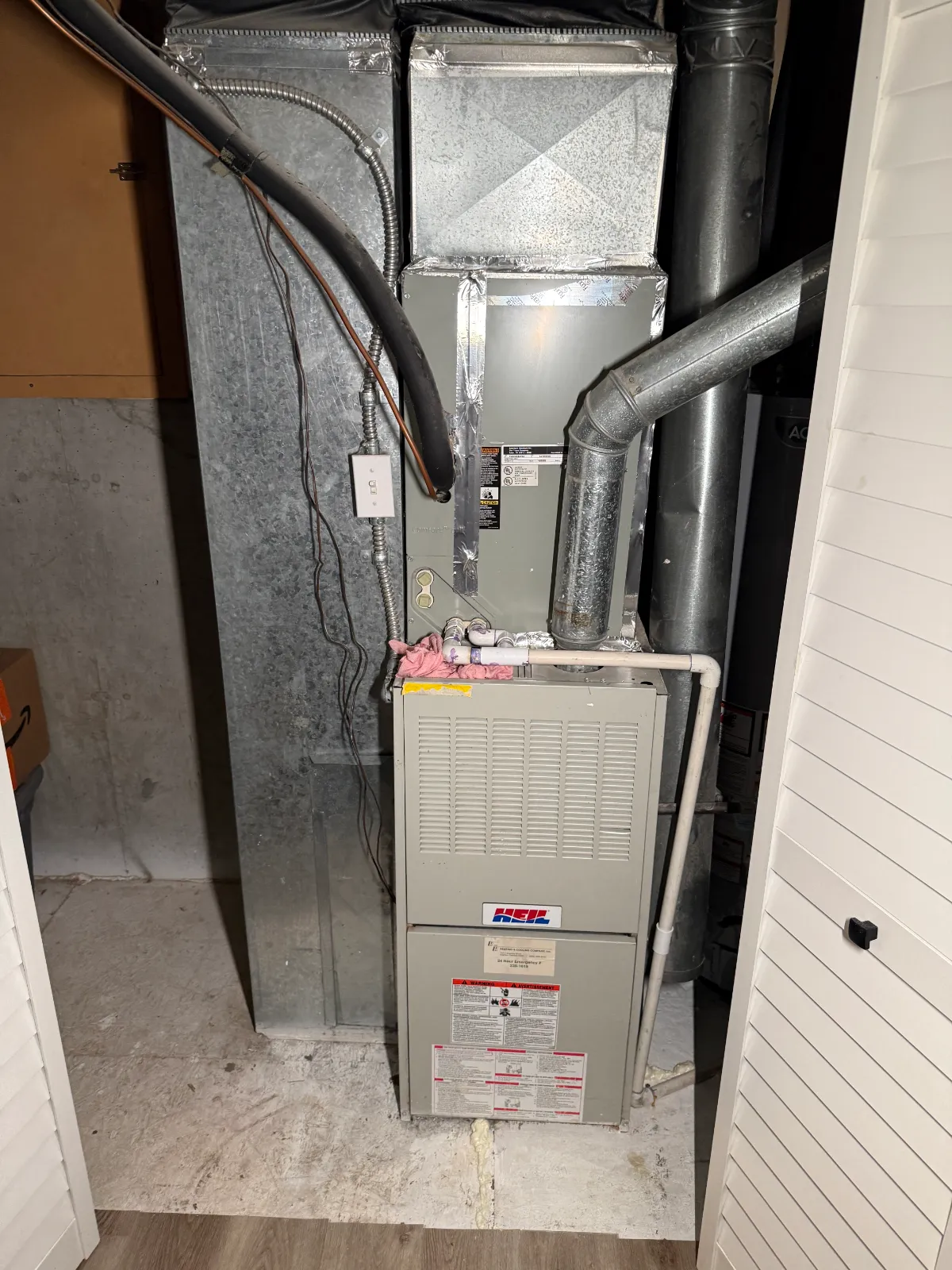
The furnace leaves the chimney and gets its own PVC vent. That can create a new problem. In many older Denver homes, the water heater shares the chimney with the furnace. Once the furnace is gone, the water heater is left alone in a flue sized for both. Industry writing in Contractor magazine calls this an orphaned water heater. A small appliance in an oversized, cold masonry flue may not draft well. Exhaust can cool, condense and damage the chimney, and the water heater can back-draft combustion gases, including carbon monoxide, into the house. The same article notes that many codes require a properly sized liner in this situation.
The two standard fixes are:
- Reline the chimney to fit the water heater. HomeAdvisor puts chimney liner installation at about $1,500–$5,000 (average about $2,500), though that figure is mostly based on fireplace work, and a water-heater liner is often at the lower end.
- Replace the water heater with a power-vent or direct-vent model and retire the chimney. Remember that new gas water heaters in Colorado must also meet ultra-low NOx limits.
Ask every bidder: "Where will the new vent and condensate drain run, and what happens to the water heater on the old chimney?" If a quote moves you to a 95% furnace without answering that, it is incomplete. Our carbon monoxide safety guide explains why back-drafting matters.
Altitude kits and setup at 5,000–7,000 feet
Furnaces are rated at sea level. At Front Range elevations the air carries less oxygen, so a burner fed its full sea-level gas rate runs rich. Manufacturer manuals we reviewed (Amana and Goodman) call for reducing input by about 4% for every 1,000 feet once above 2,000 feet. At 5,280 feet that is about 21%, so an 80,000 Btu/h furnace fires at roughly 63,000 Btu/h.
What this means for your quote:
- The conversion is not optional. It usually involves smaller gas orifices and, on many models, a high-altitude pressure switch or kit specified in the installation manual. It should never be done by turning manifold pressure below the nameplate value.
- Size after the derate. A load calculation tells you how much heat the house needs. The furnace's derated output, not the sea-level label, has to meet it. That is one reason a straight "same size as the old one" swap can be wrong in either direction.
- Insist on a combustion test. A technician with a combustion analyzer can confirm the burner is clean and CO is low after setup. Ask for the readings.
We found no published price for altitude kits on their own. They are usually a small part of the total, but ask that the conversion be listed on the quote so you know it's included. Our Colorado HVAC altitude guide has a town-by-town derate table.
Permits, inspections and other line items
Denver and most metro cities require a mechanical permit to replace a gas furnace. Angi's Denver HVAC page lists a Denver mechanical permit at about $100–$275 for most residential replacements. HomeGuide's national figure for HVAC permits is about $100–$250, and it notes contractors usually roll the fee into the estimate. Permit fees vary by city across the metro, so check with your local building department if you live outside Denver.
A permit isn't paperwork for its own sake. It triggers an inspection of the gas connection, venting and clearances. Colorado law also requires working carbon monoxide alarms near sleeping rooms when a fuel-fired appliance is replaced under a permit, so plan for that as part of the job.
| Line item | Typical range | Source |
|---|---|---|
| Old furnace removal and disposal | $150–$400 if not included | HomeGuide |
| Minor duct sealing and repair | $300–$1,500 | HomeGuide |
| Ductwork replacement | $1,400–$5,600+ | HomeGuide |
| Chimney liner (if needed) | $1,500–$5,000 (avg. about $2,500) | HomeAdvisor |
| Thermostat | $140–$350 installed | HomeGuide |
| Mechanical permit, Denver | $100–$275 | Angi Denver |
Single-stage, two-stage or modulating?
Beyond AFUE, the burner type changes comfort and price:
- Single-stage furnaces run at full fire every time. They are the cheapest and simplest, but on mild days they heat quickly and shut off, which can feel uneven.
- Two-stage furnaces run on a low fire most of the time and switch to high on cold nights. Longer, gentler cycles mean more even temperatures and quieter operation.
- Modulating furnaces adjust in small steps. They cost the most and make the most sense in larger homes.
If your current furnace short cycles, our guide to why a furnace keeps turning on and off explains why staging and right-sizing matter.
Should you replace the AC at the same time?
If your central AC is more than about ten years old (ENERGY STAR's replacement threshold for ACs and heat pumps), consider pricing both. The indoor AC coil sits on top of the furnace. New AC systems use R-454B or R-32 refrigerant and need a matched indoor coil, so a furnace replacement now and an AC replacement in two years can mean paying for coil work twice. Angi's Denver data shows furnace and AC together averaging about $7,935. Our AC replacement cost guide covers the cooling side.
Should you consider a heat pump instead?
If you're replacing the furnace and the AC is also old, a cold-climate heat pump, alone or paired with a smaller gas furnace in a dual-fuel setup, is worth pricing. The federal 25C credit ended for equipment installed after 2025, but heat pumps still qualify for Colorado's $1,000 state credit, $1,500 from Power Ahead Colorado in participating DRCOG communities, and Xcel Energy rebates. Installers report Xcel changed its rebate amounts on October 1, 2026. Confirm current terms before you sign. Gas furnaces alone no longer earn federal or state credits.
A heat pump isn't always the right answer. In a leaky house with undersized ducts, a well-installed furnace may be the more practical choice. Our heat pump vs. furnace comparison and 2026 rebate guide go into detail.
How to compare furnace quotes
Get two or three itemized quotes. Each one should show:
- The exact furnace model number, AFUE, and its input and output ratings.
- A load calculation (ACCA Manual J) or at least a documented reason for the size.
- The high-altitude conversion and a commitment to a combustion test at startup.
- Written confirmation that the furnace meets Colorado's NOx limit.
- The full vent plan, condensate disposal, and what happens to the water heater.
- The permit, removal of the old unit, and any duct, filter or thermostat work.
- Warranty terms, including who registers the equipment. Most major brands require registration within 60 days to get the longer parts warranty.
Wondering whether to repair instead? See our furnace repair cost guide; ENERGY STAR suggests considering replacement after 15 years. If a quote leaves you unsure, MrFixer Heating & Cooling offers a free second opinion on quotes from any company. You can also learn about our furnace replacement and furnace installation services, or call (720) 466-7983 for a free in-home estimate. Financing is available.
Frequently asked questions
How much does a new furnace cost in Denver in 2026?
Angi's Denver data puts a new furnace at about $2,914–$6,933, averaging around $4,924. A gas furnace change-out on existing ducts runs about $4,000–$10,000 on Angi's Denver HVAC page. These are market ranges, not MrFixer prices.
How much more does a 96% furnace cost than an 80% furnace?
HomeGuide lists installed 80–89% furnaces at about $3,800–$6,200 and 96%+ furnaces at about $7,500–$12,000. Venting changes when you switch types can add more.
Can I still buy an 80% furnace in Colorado?
Yes. Colorado's law limits NOx emissions, not efficiency. Ultra-low NOx 80% furnaces are sold, though there are fewer models than before 2026.
Do I need a chimney liner when I upgrade to a high-efficiency furnace?
Possibly. If your gas water heater shares the chimney, removing the furnace can leave it in an oversized flue. A properly sized liner or a direct-vent water heater is the usual fix.
Does a furnace need a high-altitude kit in Denver?
Yes. Manufacturer manuals typically call for about a 4% input reduction per 1,000 feet above 2,000 feet, roughly 21% at Denver, using the parts the manual specifies.
Do I need a permit to replace a furnace in Denver?
Yes. A mechanical permit is required. Angi lists Denver permits at about $100–$275 for most residential replacements, and contractors usually pull it for you.
Sources (17)
- angi.com angi.com/articles/how-much-does-it-cost-install-new-furnace/co/denver
- angi.com angi.com/articles/insider-s-price-guide-new-heating-and-cooling-system/co/denver
- homeguide.com homeguide.com/costs/gas-furnace-prices
- homeguide.com homeguide.com/costs/hvac-cost
- homeadvisor.com homeadvisor.com/cost/heating-and-cooling/install-chimney-liner
- contractormag.com contractormag.com/hydronics/article/20873692/orphaned-water-heaters-and-flue-liners
- leg.colorado.gov leg.colorado.gov/bills/hb23-1161
- colorado.public.law colorado.public.law/statutes/crs_25-7-1504
- carrier.com carrier.com/us/en/residential/furnaces/58su0.html
- achrnews.com achrnews.com/articles/136057-furnaces-must-be-modified-for-high-altitude-applications
- manualslib.com manualslib.com/manual/796665/Amana-Gux-X.html?page=16
- energystar.gov energystar.gov/saveathome/heating-cooling/replace
- colorado.public.law colorado.public.law/statutes/crs_38-45-103
- trane.com trane.com/residential/en/resources/blog/trane-warranties-explained/
- irs.gov irs.gov/newsroom/faqs-for-modification-of-sections-25c-25d-25e-30c-30d-45l-45w-and-179d-un
- energyoffice.colorado.gov energyoffice.colorado.gov/hptc
- poweraheadcolorado.org poweraheadcolorado.org/resources/rebate-program-overview
We'll measure the house, run a load calculation and give you written prices for each option before any work starts.
Get a Free Estimate or call (720) 466-7983